Collection · 8 games · 2–4 players
Traditional Asian Board Games
Asia's board games span the world's largest continent and some of its oldest civilisations — from Indian race games described in ancient epics to East Asian games of tiles and animals, and Central Asian strategy traded along the Silk Road. Here are eight you can play free in your browser.
From East Asia come Hong Kong Mahjong, the classic four-player tile game, Dou Shou Qi (“Jungle” / Animal Chess) where a rat can fell an elephant, and Korea's Lunar New Year race game Yut Nori. From South Asia come Pachisi, India's royal cross-and-circle game and ancestor of Ludo, the Tamil mancala Pallanguzhi, and Nepal's hunt game Bagh-Chal, where tigers chase goats.
From Southeast Asia comes Surakarta, a Javanese game with unique loop-around-the-corner captures, and from the Silk Road oases of Xinjiang comes Fangqi, a grid game of forming squares to capture. Together they show how widely the idea of the board game travelled — and how differently each culture shaped it.
The games

China
Hong Kong Mahjong
Mahjong emerged in China in the mid-19th century and became so culturally embedded that during the Cultural Revolution the government tried — and failed — to suppress it as a symbol of bourgeois leisure.
China
Dou Shou Qi
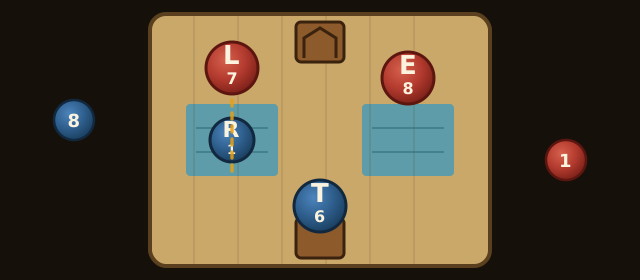
Dou Shou Qi (斗兽棋, "the game of fighting animals," also called Jungle or Animal Chess) is a popular Chinese strategy game, beloved by children across the Far East.
Indian Subcontinent
Pachisi
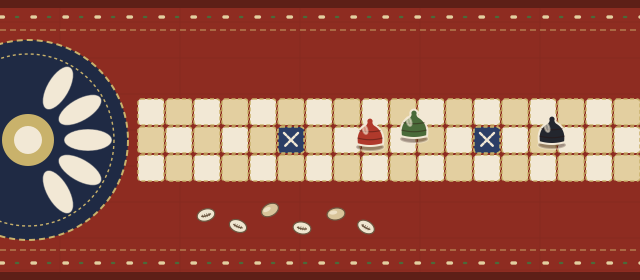
India's royal game, documented in the Mahabharata as Chaupar and played across the subcontinent for at least 1,500 years.

South India
Pallanguzhi
An ancient Tamil mancala with a 14-cup board, played across South India and Sri Lanka for at least two thousand years.
Nepal
Bagh-Chal
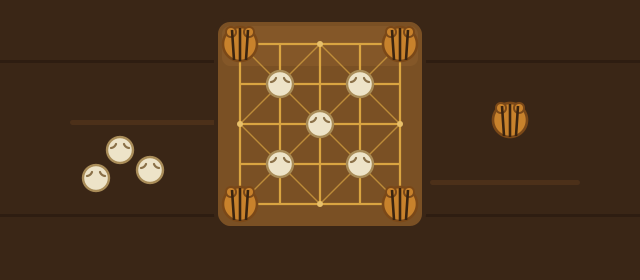
Bagh-Chal — "moving tigers" — is widely regarded as Nepal's national board game, a centuries-old contest kept alive largely by oral tradition.

Indonesia
Surakarta
Surakarta is an abstract strategy game from Central Java, Indonesia, named after the historic court city of Surakarta (Solo), where the board was traditionally scratched in the dirt and played with stones and cowrie shells.

Korea
Yut Nori
Korea's classic Lunar New Year race game — throw four wooden sticks and race all your horses around the cross-shaped board.

Xinjiang
Xinjiang Fangqi
A grid-based strategy game from Xinjiang — the ancient crossroads of Chinese, Turkic, and Persian cultural spheres — played along Silk Road trade routes where it may have influenced chess variants across Central Asia.
Frequently Asked Questions
What are the most popular traditional Asian board games?
Mahjong is among the most popular traditional games in East Asia, while Pachisi and its descendants (Ludo, Parcheesi) are hugely popular across South Asia. Go, Xiangqi and Shogi are also major Asian board games beyond this collection.
What is Dou Shou Qi?
Dou Shou Qi, also called Jungle or Animal Chess, is a Chinese strategy game on a 7x9 board where eight ranked animals cross rivers and traps. Its charm is the exceptions: the rat can swim and capture the elephant, and lions and tigers leap across the water.
Can I play Asian board games online for free?
Yes. Cultural Games offers free, browser-based versions of Mahjong, Dou Shou Qi, Pachisi, Pallanguzhi, Bagh-Chal, Surakarta, Yut Nori and Xinjiang Fangqi, playable against the computer or a friend with no download or account.
What is the oldest Asian board game?
Pachisi (and the related Chaupar) is one of the oldest, described in Indian literature and played for well over a thousand years. Many Asian board traditions, including early forms of chess, also trace back more than a millennium.